Long Before the Truck Turns Over
The route map sits on a desk, marked with red lines around bridges and weigh stations, and permits are stacked beside the phone. A driver and a dispatcher trace the path one more time, asking questions about overhead clearances and where to stop for the night. It is the day before a heavy transport rolls, and almost everything that matters has already happened. Planning an I-80 heavy transport job takes far more time than the haul itself, and the success of any move starts with the prep work no one outside the office ever sees.
Heavy hauling is one of the few jobs where the truck and the road are only part of the equation. Every state has its own permit rules, every county has its own road weight limits, and every load has its own quirks. The miles get easier when the paperwork, the route, and the equipment are sorted before the keys ever turn.
Knowing the Load Before Anything Else
Every haul starts with the cargo. Dimensions, weight, balance points, axle distribution, and tie-down points shape the rest of the plan. A 50,000-pound transformer behaves differently than a 50,000-pound piece of farm equipment, and the route, trailer, and rigging choices have to match.
A clear picture of the load tells the planner what permits will apply, what trailer is the right fit, and what kind of escort vehicles may be required. Skipping this step is how rigs end up stuck under low bridges or turned away at weigh stations.
Mapping the Route Mile by Mile
The route is rarely the most direct path. Heavy haul routing has to account for bridge ratings, tunnel heights, low overpasses, sharp turns, and roads where wide loads are restricted by time of day. A planner pulls state DOT maps, checks current construction notices, and often calls counties directly to confirm a road can carry the load.
Small detours added at the planning stage save hours of headache later. Drivers may also reach out to other carriers who have moved through the same corridor recently, since DOT records do not always catch the most current restrictions.
Permits, Escorts, and Communication
Most heavy transports require state and sometimes county permits, which can take days to secure. The list of moving parts grows fast:
- Single-trip overweight or oversize permits in every state crossed
- Pilot car requirements based on load width and length
- Police escorts for the largest loads or specific bridge crossings
- Curfew restrictions in metro areas during rush hour
- Holiday and weekend travel rules that vary by state
Each piece affects timing and cost. Planning heavy-duty transport that crosses several states means lining up these items in sequence, since one denial can ripple through the schedule. Honest communication with the customer about real timelines is part of the job from day one.
The Equipment and the Crew
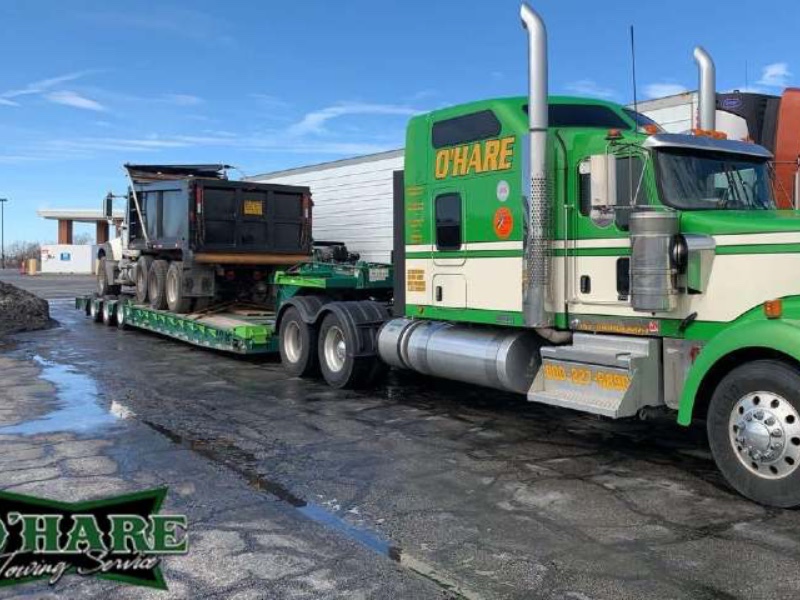
The right trailer is the next decision. A lowboy, a step deck, an RGN, or a multi-axle stretch trailer each fit different loads and different roads. An I-80 heavy transport for an oversized excavator, for example, may need a multi-axle trailer with steerable rear dollies to clear tighter turns.
The heavy equipment transport crew matters as much as the rig. A solid I-80 heavy transport call usually has a primary driver, a relief driver for long pulls, one or two pilot car operators, and a dispatcher tracking the load in real time. Every member knows the route, the load, and the contingency plan if conditions change.
How O’Hare Towing Approaches Every I-80 Heavy Transport
At O’Hare Towing, every I-80 heavy transport call gets the same planning attention, from a 40,000-pound machine to a multi-axle oversized load. Our roots go back to 1963, when Jack Gratzianna opened the doors with heavy-duty towing and recovery as the original focus. Four terminals across the Chicago area and more than 100 pieces of equipment later, that focus has only grown.
If you have an I-80 heavy transport that needs to move across the Chicago corridor or beyond, our dispatchers, drivers, and recovery specialists are ready to map the route and put the right rig under it. Call us, and we will start the plan together.
Frequently Asked Questions
How far in advance should I book a heavy transport?
For most jobs we recommend at least one to two weeks of lead time, longer for multi-state moves or unusually large loads. That window allows time to gather load details, apply for permits in every state crossed, coordinate any pilot cars, and confirm the right trailer is available.
What is the difference between an oversize load and an overweight load?
Oversize refers to a load that exceeds the legal width, height, or length for a standard trailer, usually wider than 8 feet 6 inches or taller than 13 feet 6 inches. Overweight refers to gross or axle weight beyond the federal or state legal limits. Some loads are both, and each condition triggers its own permit and escort requirements.
Can a heavy haul travel at any time of day or week?
No. Many states restrict oversize and overweight moves to daylight hours, ban travel during weekday rush hours in urban areas, and prohibit movement during certain holidays and weekends. Each state and sometimes each county has its own rules, which is one reason routing matters as much as it does.
How do pilot cars communicate with the truck driver?
Pilot cars and the lead truck stay on a shared CB or two-way radio channel throughout the trip. The pilot in front scouts for low clearances, lane closures, and tight turns, while a rear pilot watches for traffic and warns of approaching obstacles. Hand signals and brake lights serve as a backup if radios fail.
What is the difference between a lowboy and an RGN trailer?
A lowboy is a fixed-frame trailer with a low deck for hauling tall loads under bridges. An RGN, or removable gooseneck, has a detachable front section that allows equipment to be driven directly onto the deck rather than craned on. RGNs are common for self-propelled machinery, while lowboys cover taller or fixed cargo.
What happens if the cargo shifts during transit?
A trained driver pulls over at the safest available point, secures the load with extra straps or chains, and contacts dispatch to determine if the trip can continue. Loads that shift significantly may require offloading, reloading, and a re-inspection before the haul resumes. Catching the issue early is far better than discovering it after a turn.